
21/03/2018

Below, the reader is introduced to the first piece in our series of articles, which aims to provide a deeper insight into recent scientific results related to psychological measurement, in this case to the world of 360 degree measurements and questionnaires.
Competency questionnaires (or "competency tests") are standardized measuring instruments. Most often, information solicited in a 360-degree feedback process will include feedback from an employee's subordinates, peers (colleagues), and supervisor(s), as well as a self-evaluation by the employee themselves. Such studies, in which we get information about the candidate's workplace behaviour from different perspectives, are referred to as a 360-degree.
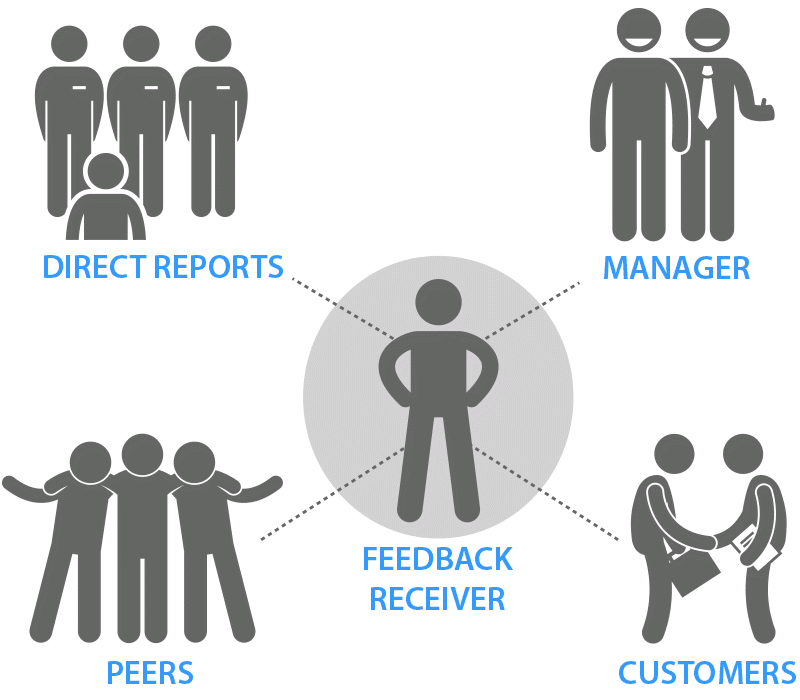
The modell of the 360-degree questionnaires
Three researchers conducted a meta-analysis of 24 longitudinal (long-term) studies. They were wondering whether the 360-degree tests had the developmental effect. It was found that performance improvement most likely occurs when
- the feedback indicates that change is necessary and the feedback recipients have a positive attitude toward the evaluation process,
- admits the need of behavioural change,
- believes that change can be achieved,
- sets achievable goals,
- takes actions that lead to skill and performance improvement.
After detailing the results, the researchers advise other researchers and practitioners that, instead of asking “Does multisource feedback work?”, ask themselves:
„Under what conditions and for whom is multisource feedback likely to be beneficial?”
You can find our list of reliable competency measurement tools here. Our sample reports will give you an informative insight into what kind of report we are able to generate with it.
The report can be viewed by clicking on the image
Our readers can gain insight into the usefulness of the method, about the background of the tool and how to use it optimally at the SHL Training Academy’ practical, one day long training on 17th of May.
Sign up for this training if you want to learn the method to be able to recognise your colleagues strenghts and weaknesses quickly and effectively!
Sources
Klein Balázs, Klein Sándor (2006): A szervezet lelke. EDGE 2008 Kiadó, Budapest.
W. Smither, James & London, Manuel & Reilly, Richard. (2005). Does Performance Improve Following Multisource Feedback? A Theoretical Model, Meta-Analysis, and Review of Empirical Findings. Personnel Psychology. 58. 33 - 66.
More news
